

What Is Electronic Kanban and Where Is It Used?
Companies hold more critical materials closer to production while trying to avoid excessive inventory levels. Less predictable supply chains drive organizations to focus on automating replenishment to ensure material availability.
What Does Electronic Kanban Mean?
Kanban is a replenishment method where material consumption triggers the next supply action. In a traditional Kanban process, this signal can be a card, an empty bin, a label, or another visual indicator.
Electronic Kanban uses digital technologies to signal the need to replenish materials as they are consumed. Electronic Kanban systems automate the traditional Kanban principle. The goal is to make the replenishment signal faster, easier to track, and less dependent on manual handling.
Why Are Companies Using Electronic Kanban?
Traditional Kanban processes rely on employees handling cards, recording replenishment needs, and moving information between different systems. These manual activities create delays, missed replenishment requests, and additional administrative work, especially in large organizations. Electronic Kanban addresses these challenges by automating replenishment signals and inventory monitoring.
Reliable Material Availability
🏭🏭🏭
Electronic Kanban generates replenishment requests based on actual inventory events. This reduces the risk of missed replenishment signals and helps ensure that materials remain available where they are needed.
Reduced Administrative Work
📝📝📝
Traditional Kanban processes require employees to handle cards, record transactions, and communicate replenishment needs. Electronic Kanban automates these activities, reducing manual effort and supporting standardized replenishment processes.
Replenishment Based on Actual Demand
📈📈📈
Material consumption rarely follows fixed patterns. Electronic Kanban continuously monitors inventory status and consumption, allowing replenishment activities to respond more quickly to changing demand.
How Does Electronic Kanban Work?
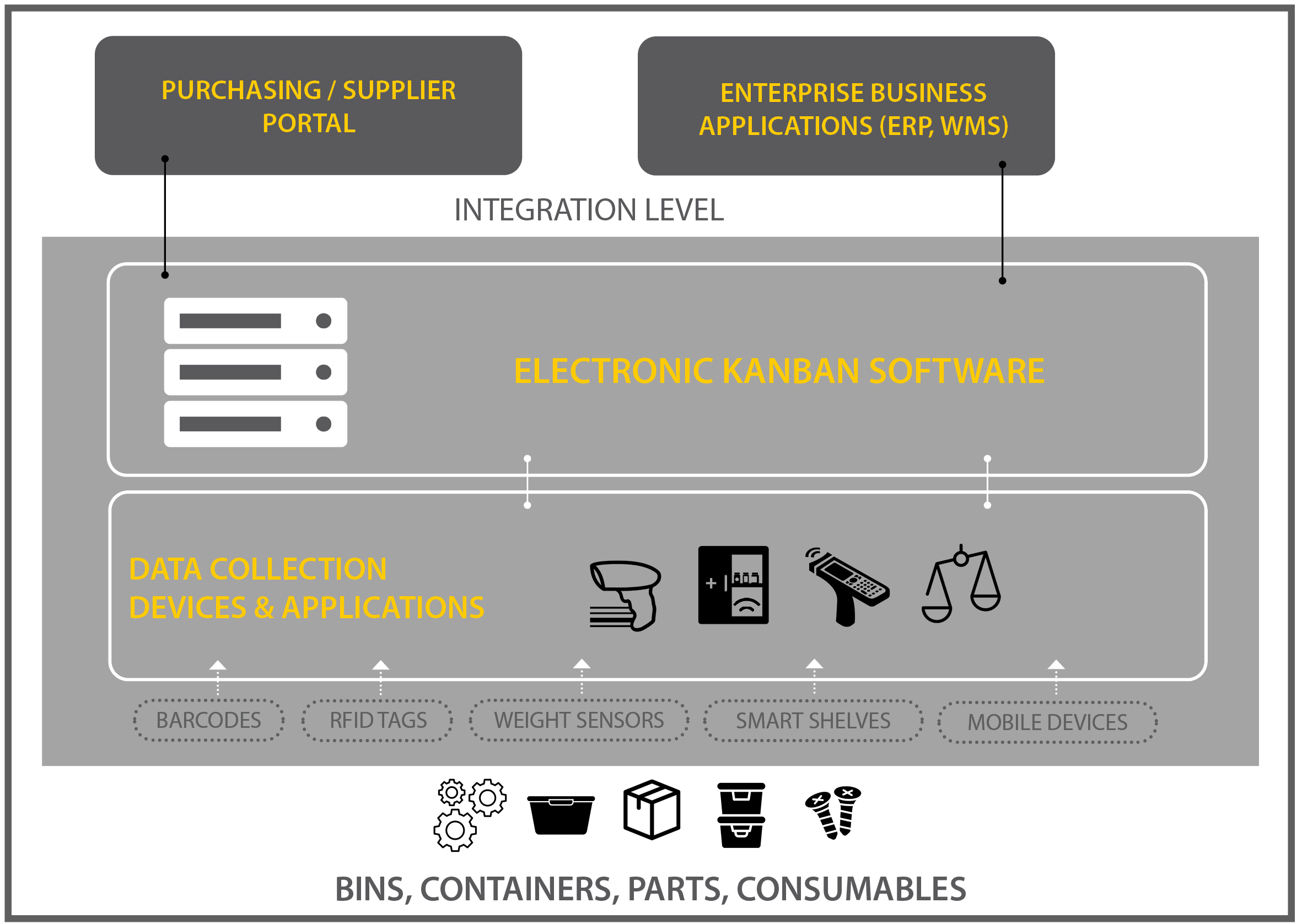
Electronic Kanban systems connect physical inventory locations with software that monitors inventory status and manages replenishment activities. Inventory events are captured using technologies such as RFID tags, barcodes, weight sensors, smart shelves, and mobile applications. The collected data is processed by Electronic Kanban software, which can trigger replenishment requests, notify users, and exchange information with ERP, WMS, purchasing, or supplier systems.
The system typically consists of the following layers:
- Materials and Inventory Locations – Electronic Kanban is commonly used to manage bins, containers, spare parts, consumables, production materials, and other inventory items that require regular replenishment. Either the bin / container or the physical location is saved as the location in the system.
- Data Collection Technologies – Technologies such as RFID, barcodes, weight sensors, smart shelves, or apps on mobile devices help identify the materials or their bins/containers.
- Data Collection Devices and Applications – Readers, scanners, sensors, mobile applications, and connected devices capture inventory events.
- Electronic Kanban Software – The software maintains inventory status, applies replenishment rules, generates notifications, and creates replenishment requests based on predefined inventory parameters.
- Business System Integration – Inventory and replenishment data can be exchanged with ERP systems, WMS platforms, purchasing applications, supplier portals, and other business systems involved in material planning and ordering.
Although implementations vary, most Electronic Kanban solutions follow the same basic structure shown below.
Which Technologies Support Electronic Kanban?
Electronic Kanban is a process, not a specific technology. Different methods can be used to identify inventory items, detect material consumption, and trigger replenishment activities. The right technology depends on factors such as inventory value, required accuracy, operating environment, and process complexity.




Barcodes
A low-cost option for identifying materials and containers. Barcode-based Electronic Kanban typically relies on employees scanning items or Kanban cards to trigger replenishment events.
RFID
RFID enables automatic identification without line-of-sight scanning. Depending on the application, RFID can support container tracking, inventory visibility, automated replenishment signals, and real-time inventory updates.
Mobile Applications
Mobile devices allow users to register inventory events, confirm replenishment activities, perform stock checks, and access Electronic Kanban information directly at the point of use.
Smart Shelves, Cabinets & Weight Sensors
Weight sensors and smart shelves continuously monitor inventory levels. Replenishment requests can be generated automatically when stock falls below predefined thresholds.
No single technology is suitable for every Electronic Kanban process. Many organizations combine multiple technologies to balance automation, cost, and operational requirements.
For a more detailed comparison of RFID, RTLS, barcode, sensor, and other identification technologies, see our article: How to Choose the Right Technology: From RFID to RTLS Asset Tracking and Beyond.
Where Is Electronic Kanban Used?
Electronic Kanban is used wherever materials need to be replenished reliably without creating excess inventory. The process is common in manufacturing, maintenance operations, healthcare, warehouses, and other environments where employees consume materials throughout the day.
Typical applications include:
- Production Materials – Components, assemblies, and consumables used directly in manufacturing processes.
- Maintenance, Repair and Operations (MRO) – Spare parts, tools, personal protective equipment, and maintenance supplies.
- Healthcare Supplies – Medical products, consumables, and department inventory requiring continuous availability.
- Warehouse and Logistics Operations – Packaging materials, labels, pallets, and other frequently replenished inventory.
- Shared Inventory Locations – Cabinets, shelves, vending solutions, and self-service stores used by multiple employees or departments.
Although Electronic Kanban is often associated with manufacturing, the same replenishment principles can be applied wherever inventory consumption needs to trigger a timely replenishment action.

RFID and Electronic Kanban
Electronic Kanban describes the replenishment process, while RFID is one of the technologies that can be used to support it. Organizations can implement Electronic Kanban using barcodes, mobile applications, smart shelves, weight sensors, RFID, or a combination of these technologies.
RFID has become a popular choice because it enables automatic identification of materials, containers, and inventory locations without requiring line-of-sight scanning. Inventory events can be captured automatically as materials are consumed, moved, replenished, or returned, reducing the need for manual data collection.
This automation can improve inventory visibility, reduce administrative work, and support more accurate replenishment decisions. RFID is particularly well suited for environments where large numbers of inventory transactions occur each day or where minimizing manual scanning activities is a priority.
However, RFID is not a requirement for Electronic Kanban. The most suitable technology depends on the replenishment process, operating environment, required level of automation, and business objectives.
You might also find these interesting
RFID Kanban
RFID monitors inventory consumption and triggers replenishment automatically.
The solution supports common replenishment models such as two-bin Kanban and supplier-managed inventory.
Article
Choosing the Right Tracking Technology
Barcodes, RFID, GPS, and RTLS all support asset visibility — but in different ways.
This article helps to understand their strengths and how to apply each technology to build connected, transparent supply chains ready for digital compliance.
Track & Trace Platform
Reducing Errors for a Sustainable Future
Our Track & Trace Platform connects barcodes, RFID, RTLS, and IoT data in one system for asset visibility and ERP integration.
Connecting several tracking technologies helps collect data throughout the supply chain and provides reliable compliance reporting.
consultancy
Assess Your Organization's RFID Readiness
Meet with our expert to review your traceability setup and identify gaps in data. Together, you’ll outline practical next steps toward a Track & Trace solution that best fits your company.