
What does RFID mean?
RFID stands for Radio Frequency Identification, a technology that uses radio waves to identify and track objects automatically. It is one of the key AIDC (automatic identification) technologies alongside barcodes and RTLS.
RFID systems use small tags attached to items. These tags, also known as transponders or smart labels, store data that can be captured wirelessly by RFID readers without direct line of sight.
The system consists of tags, hardware such as readers and antennas, and software that collects and processes the data.
Why RFID?
RFID is used when reliable identification and visibility are critical for operations.
Compared to visual identification methods such as barcodes, RFID removes the need for manual scanning and direct line of sight. Data is captured automatically, at speed, and across multiple items at once. This reduces dependency on human input and makes processes more consistent and predictable.
If you want to understand how RFID compares to other tracking technologies such as barcodes, BLE, UWB, or GPS, see our guide on choosing the right tracking technology.
In practice, RFID translates into clear operational impact by removing inefficiencies and improving how operations run.
Operational inefficiencies that RFID helps tackle
How RFID improves operational reliability
Manual searching and missing visibility
→ people looking for materials, tools, assets
Real-time visibility of materials and assets
→ always know where things are
Human errors in processes
→ wrong shipments, wrong items, wrong inputs
Accurate and error-free processes
→ correct shipments, correct production inputs
Manual data capture and rework
→ scanning, typing, correcting
Automated data capture and workflows
→ no manual registration needed
Process delays and waiting time
→ things not moving because status is unclear
Faster, more predictable operations
→ flow instead of firefighting
What is RFID used for?
RFID is used to automatically identify, track, and manage physical items across a wide range of operations. The technology works without line of sight and automates data capture, reducing manual errors. RFID applications monitor material whereabouts and usage and capture data products, and assets in real time.
Business Enterprise Systems (such as ERP or WMS systems) rely on user input and thus the data is only as accurate as data submitted by a user. RFID bridges the gap between the physical world and the business system by automating the data input. This supports more accurate inventory management, better process control, and improved visibility across supply chains and production environments.
RFID is used in a wide range of real-world applications across industries. Some common examples include:
Different RFID frequencies
RFID is commonly categorized based on operating frequency. The main frequency ranges are low frequency (LF), high frequency (HF), ultra-high frequency (UHF), and near-field communication (NFC), each suited to different environments and use cases.
In practice, users often relate to RFID through its applications rather than frequency. For example, UHF is widely used in logistics and manufacturing, while HF and NFC are common in access control, ticketing, and contactless payments.
RFID systems are also sometimes described as passive or active. Passive tags do not have a battery and are powered by the reader signal, while active tags use a battery. Today, many active RFID use cases have been replaced by other real-time locating technologies.
RFID is already omnipresent in our lives
The usage environment determines which RFID frequency is used. Here are some everyday examples of where you may already encounter RFID.

Low Frequency RFID (LF)
Low Frequency RFID is used to tag and track livestock and pets.
High Frequency RFID (HF)
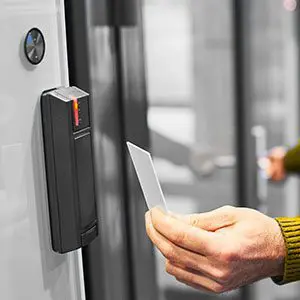
High Frequency RFID is used in entrance control and controlling production lines

Ultra High Frequency (UHF)
UHF RFID ensures automatic capture of masses of data and hence automates inventory management in retail and warehouses

Near-Field Communication (NFC)
Near-Field Communication (NFC) is commonly used in payment and other high-security applications
From RFID basics to real-world solutions
In practice, RFID is part of integrated track & trace systems combining tags, readers, and software—often alongside other AIDC technologies such as barcodes, GPS, or RTLS.
Track & Trace Solutions Powered by RFID
Every process can be streamlined. Material, inventory, and asset tracking solutions produce actionable knowledge for better visibility, traceability and efficiency.
Almost any object can be equipped with a UHF RFID or RTLS tag. Once tagged, the object leaves a digital trace that business processes use for supply chain automation.
As product lifecycles become shorter and the amount of SKUs grows, supply chains must evolve to be more efficient. Explore real success stories that demonstrate digital supply chains.
A technical overview of how AIDC technologies vary and the criteria for selecting the right fit for asset tracking applications.